
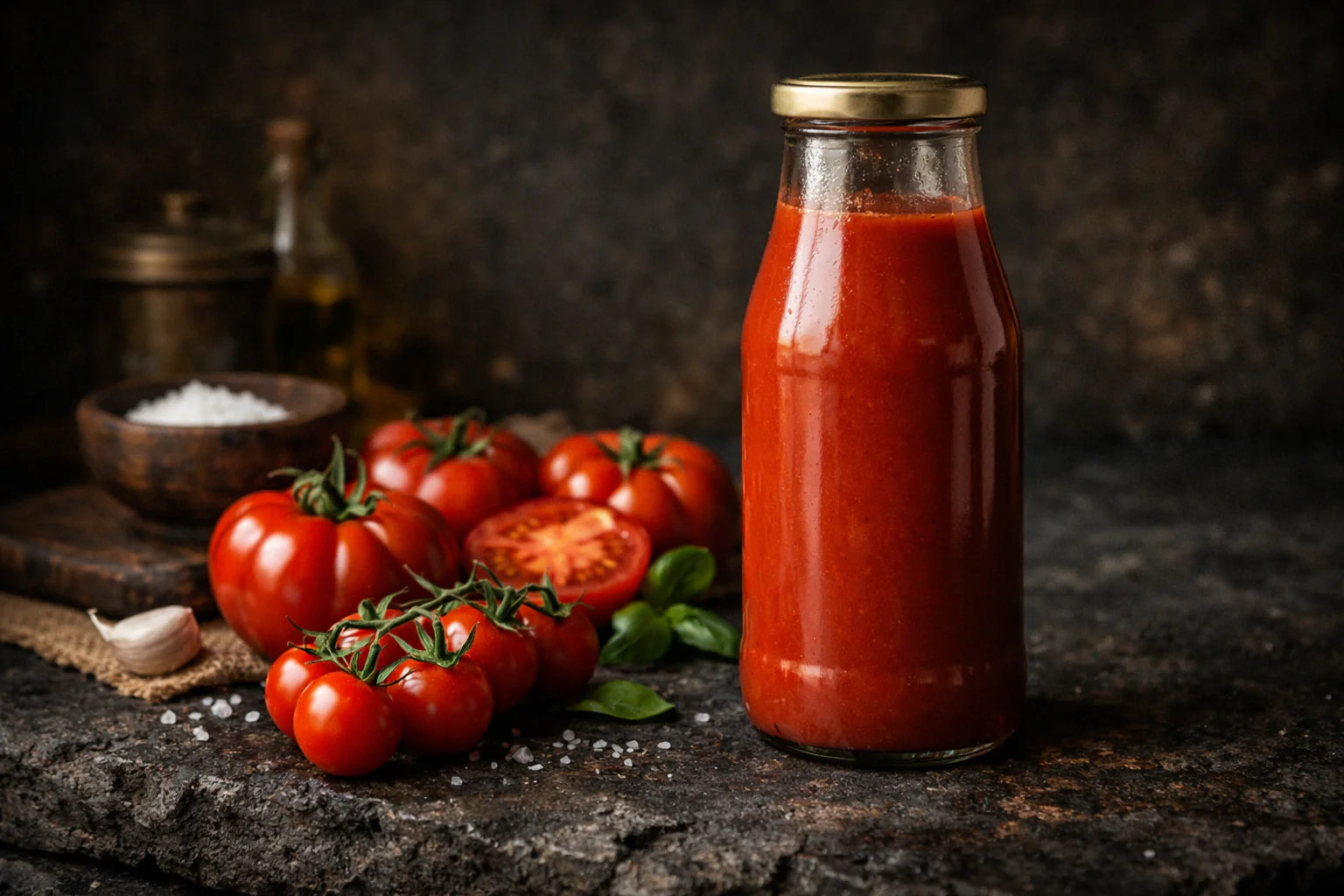
The guide to recognizing true quality (and not being fooled)
Tomato passata is one of the most common ingredients in Italian kitchens.
And precisely for this reason, it is also one of the most misunderstood.
Shelves full, reassuring labels, words like “artisan,” “traditional,” “like in the old days.” But what does quality truly mean when we talk about passata?
Knowing how to choose makes the difference between a bland sauce and a dish that smells of the land.
This guide is designed to help you recognize a truly artisan passata, one that transforms your cooking in just a few steps.
🔍 1. Read the label
The first filter is always there: the ingredient list.
A true artisan passata must be clean and legible.
✅ What to look for
-
tomatoes
-
possibly salt
-
nothing else
❌ Red flags
-
tomato concentrate
-
added sugars
-
unnecessary acidity regulators
-
flavorings
👉 The shorter the list, the more serious the product.
💬 Quick rule: if you wouldn't make it that way at home, it's not truly artisan.
🌋 2. Origin of the tomato: the real differentiator
Not all tomatoes are created equal.
The soil, climate, and harvesting radically change the result on the plate.
A quality passata must clearly state:
-
origin of the tomatoes
-
cultivation area
-
traceable supply chain
In the Vesuvian area, for example, the volcanic soil naturally provides:
-
greater savoriness
-
balanced sweetness
-
mineral tension
👉 These are characteristics that cannot be "added" afterwards.
👀 3. Look at the color (without being fooled)
Many people think that the more intense red the passata is, the better it is.
This is not always true.
A quality artisan passata has:
-
a vibrant but natural red
-
not too bright
-
not dull brownish
Watch out for:
-
reds that are too bright (may indicate intense processing)
-
dull or oxidized colors
-
excessive water/pulp separation
💬 Chef's trick: lightly shake the bottle — the consistency should be fluid but not watery.
🧪 4. The right consistency
A good passata should be:
-
velvety
-
homogeneous
-
not gelatinous
-
not too liquid
When you pour it onto a plate, it should coat the spoon, not slide off like water.
👉 This is a sign of processing that respects the pulp.
👃 5. The aroma never lies
Open the bottle: your nose tells the truth first and foremost.
An artisan passata smells of:
-
fresh tomato
-
clean pulp
-
natural vegetable notes
Be wary if you smell:
-
overly intense cooked odors
-
aggressive acidic notes
-
metallic hints
💬 The aroma should recall freshly processed tomato, not already cooked sauce.
🍝 6. How it performs in the pan (the final test)
The real judgment always comes during cooking.
A quality passata:
-
thickens naturally
-
does not release too much water
-
maintains a vibrant color
-
develops sweetness without sugar
👉 After 10-12 minutes, you should already feel the sauce "binding."
If it remains watery or too acidic, the raw material was not up to par.
🖤 The Nero Vesuviano selection
At Nero Vesuviano, passata only enters the catalog when it meets a precise criterion: traceable supply chain, clean processing, real performance in the kitchen – only then does it become a Nero Vesuviano label.
Because a passata shouldn't just be good on paper — it must truly work on the plate.
🛒 Want to try a selected passata?
Discover the Nero Vesuviano collection of Vesuvian passatas and bring clarity-speaking tomatoes to your kitchen.
